COMMIT TO CHANGE (a how to guide)

COMMIT TO CHANGE (a how to guide)

Have you ever had something hard to do? Maybe there is an attitude that you want to correct, a habit that’s gotten the better of you or something you know you need to do. But even when you know we need to make a change it can be so difficult. How do we even start?

God gave the Israelites some help in this area. He knew that they struggled with their attitudes, habits and to do what’s right. So he began with this advice:

“And you must commit yourselves wholeheartedly to these commands that I am giving you today. Repeat them again and again to your children. Talk about them when you are at home and when you are on the road, when you are going to bed and when you are getting up.” Deuteronomy 6:6-7 (NLT)

The first step is committing ourselves wholeheartedly… which is hard to do. It’s easy to begrudgingly decide to do something. Or make a change even though you don’t want to. Or drag your feet but to it anyway. But God says we need to commit with our WHOLE heart. Need a song to get this idea flowing?

WHOLEHEARTED by: Rend Collective

Next we have to battle our forgetfulness. Have you ever gone to bed with the best intentions to make a change when the alarm goes off the next morning… just to forget why you were planning to get up early? So what does God suggest? Repetition. God tells us to repeat our commitments over and over to others. Talk about them at home and away, morning and evening.

Do you need to commit to making a change? Do you need to stop or start doing something so that you are bringing glory to God with your whole life? We all do!! Keep Deuteronomy 6:6-7 in front of your eyes this week so that you remember what God is prompting you to work on. And then do it with all your heart.

Have You Ever Read Numbers?

Have You Ever Read Numbers?

In case you are looking at the screen in confusion, Numbers is the fourth book of the Old Testament (right after Leviticus) and it has nothing to do with math. Instead, Numbers showcases the faithfulness of God. Unsettled and weary as the Israelites often were (and tempted to envy everything they left behind or saw surrounding them) they were the most blessed of ALL people. Even in the wilderness, God dwelled in their midst – no other nation had the presence of God.

I love this book because we get to see God intimately interact with people. It’s breathtaking. Scary. Exhilarating. Frightening. And nestled inside of Numbers is a truth I want to shout from the rooftops: God desires to do life with you.

But in order to do life with a holy and just God we will have to wrestle with this verse from Numbers, “The Lord is slow to anger and filled with unfailing love, forgiving every kind of sin and rebellion. But he does not excuse the guilty.” Numbers 14:18

Interestingly enough the first half that I bolded is usually where people stop the quote. And while it’s a great half – it’s only half. See the Lord is slow to anger and filled with unfailing love, but he’s also pure. He cannot live with unexcused sin, which is why we see example after example of God’s punishment of the Israelite people in Numbers.

BUT. You and I are living in a time where God’s presence is even more precious because it is accessible. United through the sacrifice of Christ and the gift of the Holy Spirit we have become the dwelling place of God. And while the Israelites could not completely escape their guilt… we can through repentance and faith in Jesus Christ.

Reading the Old Testament is a treasure of truth for our souls, helping us appreciate the true gift of a relationship with God. He wants to live with us. He wants to fight for us. He wants to walk beside us and speak with us. But he will not forgive the guilty. Which is why we need Jesus.

Have you thanked Jesus today for restoring you to God? Did you notice the relationship you now have with God? Don’t miss the heart of the one who knows you best and loves you most. In the book of Numbers, an entire generation of Israelites passed away in the wilderness under the guilt of their sin. God has provided a way back for you this very moment.

If you don’t have a personal relationship with God know that it isn’t because he’s distant. God loves nothing more than to do life with his people. He made a way to remove our guilt at great personal cost. But we have to want it. We have to choose with our lives. God desires to do life with you. Do you desire to do life with him?

Godly Sorrow: The Distress that Drives us to God

Godly Sorrow: The Distress that Drives us to God

Godly sorrow brings repentance that leads to salvation and leaves no regret, but worldly sorrow brings death. [2 Corinthians 7:10]

I will never forget the year I outlawed the use of the word, “sorry” in my sixth-grade classroom. For some reason, the majority of my students thought that simply saying the word, “sorry” gave them a free pass from any consequence or any need to change their behavior. Saying, “sorry” was the magic word that would stop any authority figure from holding them accountable for their slip-ups and misdeeds and would relieve any feelings of badness and sadness they felt, especially when they were “sorry” about being caught. “Sorry” became the word that could hide them from judgment for breaking the rules, but their version of “sorry” had no power to change their hearts or help them recognize the wounds in relationships they were causing.

So, to move my precious charges from a position of self-centeredness and complete self-absorption, I outlawed the word “sorry” and gave them other phrases to use instead. All year we worked on empathy for others, so that saying, “I have hurt you,” and “This offense is my responsibility,” had a real impact on their hearts. We worked on forgiving and the giving of grace by saying to a classmate dealing with a misstep, “That’s okay, you are still a good person.”

I borrowed a page from the Apostle Paul’s second letter to the Corinthians as I asked God for help with this tough-hearted little crew He had given me to love. Paul’s first letter to the Corinthians had really scorched their hides, demanding accountability for the sin and divisions that had turned their church into a shipwreck. Then, worrying that he had been too harsh, Paul wrote in his second letter to them, that he wanted them to feel the Godly sorrow that would lead to real change.

He wanted them to recognize how truly destructive this current sin-cycle was to their relationship with God, with one another, and within themselves. He didn’t want them to concentrate on outward behavior, but on letting the grace of God and His love penetrate their hearts. Paul wanted the Corinthians to love well, the way Jesus loves, and that meant measuring their behavior by how well they were maintaining loving, healthy relationships. He didn’t want their lives defined by hiding, regret, or being driven away from God and each other by an angry, condemning conscience.

Paul’s Holy Spirit-inspired approach inspired me to help my students move from trying harder to be good and nice and less snarky, to training their hearts to value loving well. Instead of making vows to do better and throwing out a quick, “sorry,” we worked on creating a safe environment where behavior could be evaluated without threat and tools for true change could be discovered and used. I have to admit, that the more deeply we explored this approach, the more of my own “me-sickness” surfaced. God lovingly and gracefully dealt with me, the biggest sinner in that classroom!

What about you? Would you be interested in living a life that leaves no regret, a life defined by true change and healing? Do you want out of the living death of a continuous sin cycle? Embracing Godly sorrow, rather than worldly sorrow is the key. You and I can pray for God to help us turn our perspectives outward so that we have the big picture our sin and mess are creating. The distress we feel at getting caught can be changed to a distress that drives us to a loving Father who is ready to forgive, grant us a do-over, and over time, equip us to love better. We can pray for a more sensitive heart that cares deeplywhen we hurt God, hurt others, and hurt ourselves. That is Godly sorrow. What would it look like in your life?

BY: Stephanie Murillo

For Further Study
2 Corinthians 7: 8-10
2 Samuel 12:13
1 Kings 8:47-50
Matthew 21:32
Matthew 26:75
2 Timothy 2:25-26

Twenty Critical Minutes

Twenty Critical Minutes

We demolish arguments and every pretension that sets itself up against the knowledge of God, and we take captive every thought to make it obedient to Christ. – 2 Corinthians 10:5 [NIV]

We have all heard about counting to ten when we are angry. Now neuroscientists are telling us that a twenty-minute period after strong emotions wash over us is a critical period. Why is this? The amygdala, a walnut-shaped organ in the mid-brain, whose job it is to detect threat, needs twenty minutes after it “alerts” to calm down. During that time this little organ is hijacking electrical energy from the front of the brain where we think and plan, to the brain stem where we either fight or flee.

So, the moment we become anxious, what we do with that twenty-minute period immediately afterward is critical. We can send up a 9-1-1 prayer, recite Scripture we have memorized, drink a glass of water, or take a quick walk before letting ourselves react. Immediately moving to a worst-case scenario may become our go-to strategy without a steady diet of prayer, Scripture, and reminding ourselves that God can handle even this tsunami of strong emotion.

A theologian from Proverbs 31 Ministries recently pointed out that when we react instead of respond, our actions become “historical and hysterical.” Without training, we will default to old and often ineffective strategies when we are triggered by our amygdala.

You do have a choice.

The amazing part of all this “brain stuff” is that we do have a choice about where those impulses travel when we are angry, afraid, or experiencing any strong emotion, especially during that critical twenty-minute period. But the brain must be re-trained over a fairly long period of time to “take thoughts captive” when the heat is on. When we “take a thought captive” we are literally re-routing electrical impulses down a new neural path!

The brain initially resists this because it has already created “super-highways” of connected neurons. It doesn’t want to slow down to bushwhack through a new neural tangle when learning a new strategy or response. As we pray, read the Bible, memorize Scripture and meditate on it, our brains can learn to slow down to re-tool, re-set, and restructure. When stressed, we can eventually learn to use those critical twenty minutes to pray, “Lord, calm all my fears with Your love. Help me remember Your truth.”

The key is consistent training, which includes reading, memorization, meditation on what we read, and application of truth to a specific situation, all requiring the assistance of our personal Coach, the Holy Spirit. We can also pray, “Holy Spirit, please train me and cue me and give me the energy to respond rather than react when I become triggered emotionally.”

How old are you really?

One last thought: When we react after being triggered, we go to our true emotional age rather than our chronological age. If an unresolved trauma happened between four and fourteen, we react like the age we were when we were damaged and branded by that incident. That is why people act like deranged adolescents or a toddler having a tantrum when triggered in public. So, part of emotional/spiritual development is actively seeking healing and counseling for unresolved hurts from our past. That unlocks us from our stuck places and lets us grow up to use that twenty-minute period in a healthy manner.

By the way, many of today’s Christian psychologists and counselors believe that spiritual growth and emotional growth are one and the same. When we commit to daily training with the Holy Spirit, our Coach, over time, and with God’s grace and truth, our brains can re-shape our neural thought highways so we grow up into mature strategies. God will do His part as we do our part so that fear and panic no longer hijack our healthy responses to threat and big challenges.

BY: Stephanie Murillo

FOR FURTHER STUDY

  • Philippians 4:8
  • Psalm 10:4
  • Psalm 13:2
  • Psalm 55:2
  • Psalm 139: 17, 23
  • Isaiah 55:8
  • Hebrews 3:1
  • Hebrews 4:12
  • Proverbs 31 podcast

Flip the Narrative

Flip the Narrative

I am very ugly
so don’t try to convince me that
I’m a very beautiful person
because at the end of the day
I hate myself in every single way
And I’m not going to lie to myself by saying
There’s beauty inside of me that matters
So rest assured I will always remind myself
That I am a worthless, terrible person
And nothing you say will make me believe
I still deserve love
Because no matter what
I am not good enough to be loved
And I am in no position to believe that
Beauty does exist within me
Because whenever I look in the mirror I always think
Am I as ugly as people say?

👉🏻 NOW, read from the bottom to the top! 👈🏻

It’s all about perspective! What story are you telling yourself in the mirror every single day? Flip the narrative and change the story, it will change your life. I get it, you are saying Liz… if it was that easy we’d all be problem free. And I know changing your perspective is hard. We are usually pretty committed to our perspectives. We have invested a lot in them.

Kind of like Jonah. He was a prophet and committed to telling people to repent and be saved. He did it well. So well, that when God told him to go preach repentance to Nineveh Jonah said “no way”! When he preached people changed and Jonah didn’t want Nineveh to be saved. They were BAD NEWS. So God had to give Jonah a new perspective, being swallowed by a whale.

Inside the whale Jonah finally got the idea that God was in control and God was the one who could save. He got the narrative straightened out. And once he was seeing clearly God could use Jonah again.

Is there a narrative that you need to flip? What are you telling yourself that isn’t true. Maybe you think you are in control when you need to trust. Maybe you are calling ugly what God has called beautiful. Maybe you are running from what you know God has called you to.

Flip the narrative by praying like Jonah! (chapter 2)

Then Jonah prayed to the LORD his God from the belly of the fish, saying, “I called out to the LORD, out of my distress, and he answered me; out of the belly of Sheol I cried, and you heard my voice. For you cast me into the deep, into the heart of the seas, and the flood surrounded me; all your waves and your billows passed over me. Then I said, ‘I am driven away from your sight; yet I shall again look upon your holy temple.’ The waters closed in over me to take my life; the deep surrounded me; weeds were wrapped about my head at the roots of the mountains. I went down to the land whose bars closed upon me forever; yet you brought up my life from the pit, O LORD my God. When my life was fainting away, I remembered the LORD, and my prayer came to you, into your holy temple. Those who pay regard to vain idols forsake their hope of steadfast love. But I with the voice of thanksgiving will sacrifice to you; what I have vowed I will pay. Salvation belongs to the LORD!” And the LORD spoke to the fish, and it vomited Jonah out upon the dry land.

Creative Conflict

Creative Conflict

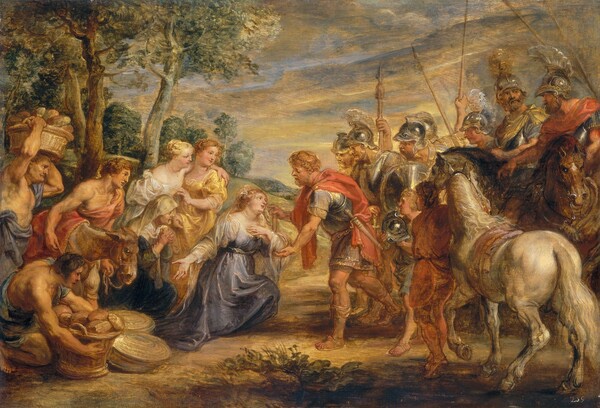
How do you handle conflict? Do you avoid it at all costs? See it as demoralizing and fearful? Or might you perceive conflict as an opportunity for growth and a strengthening of bonds? The Bible has a compelling story of creative conflict management in 2 Samuel 17. Take a moment to read the story of two hot-heads, David and Nabal, and one creative thinker, negotiator and communicator named Abigail.

When Nabal is asked by King David’s servants for a hand-out, he reacts by insulting the king, refusing to meet their desperate need for food. David does not stop to think, pray, or assess the situation. He, like Nabal, puts his foot on the emotional gas and threatens to leave no son of his alive because of this drunken fool’s refusal. When Abigail learns that death now threatens her family, she calmly stays in touch with her feelings and carefully considers how to respond. Abigail empathizes with David’s plight, staying calm, non-defensive and respectful when she takes food to David.

She faces the conflict head-on, but respectfully seeks a win-win for both her family and for David, refusing to be paralyzed by anger or fear. Then this resourceful woman communicates to David that the blood-shed he is contemplating is going to hurt his relationship with God then asks the king to forgive her husband and to hold nothing against her. Abigail boldly advocates for herself asking David to remember her when the conflict is resolved.

You and I can benefit from Abigail’s conflict-resolutions skills if we are willing to ask the Holy Spirit to help us put the following strategies into practice:

  1. Let go of the need to win or be declared right. We can effectively handle conflict when our goal is the restoration of relationship, not winning. We need to be reminded that God loves us whether we are top dog or not.
  2. Let go of the past. Focus on the present, not past grudges, so that what can be done in the here-and-now isn’t lost in chaotic memories.
  3. Let go of the need for revenge. We can resolve conflict if we release the urge to punish and if we are willing renounce the following: dwelling on the incident, bringing it up again, re-hashing the incident with others, and letting the incident stand between us and others.
  4. Let go and disengage when a discussion is not fruitful. We can often try again especially after learning better communication skills and seeking the help of professionals in this area.
  5. Let go of the need to handle conflict without help. God is happy to give us wisdom and discernment when we ask Him for help in hard-to-have conversations. We can ask God for a strengthening of our character for stronger conflict resolution skills and for safe others to guide us.

Any conflict has the potential to teach us about ourselves and deepen our understanding and empathy for others. As you and I are willing to work with God and safe others on our own issues, we will learn to respectfully approach others when conflicts arise. God’s desire is always the re-creation of deep and healthy connections in our relationships.

For further reading:

  • Ephesians 4:32
  • Matthew 6:14
  • Proverbs 15:1, 2, 4, 18, 22, 28, 32

BY: Stephanie Murillo

[Art Note: Painting is oil on panel by Sir Peter Paul Rubens entitled The Meeting of David and Abigail circa 1630.]

Easter Resolutions

Easter Resolutions

When 2021 came around it was universally accepted that we were out with the old and in with the new. Of course we hoped to be “out” with masks, social distancing & eating outside and “in” with hugs, parties & traveling. We made personal resolutions to stop eating so much and spend more time at the gym. And whether any of the outs really out-ed or ins really in-ed was never exactly the point, it’s the ferver with which we HOPE things will change when the calendar does that wins our hearts every year.

Easter is the Christian new year. Lent begins the holiday season and by Easter we are always primed to make our spiritual resolutions. This year I will stop taking Jesus for granted and have a relationship with God. This year I will trust God with my finances and start to tithe. This year I will put down the idol that I’m so drawn towards (drinking, food, shopping, relationships, money, etc.) and focus on letting God fill my emptiness. In the final Easter sermons we are primed for repentance.

But as Paul says to the Galatians, who cut in on you? I’m guessing that already (April 14th) you’ve messed up your resolution. I know I have! Galatians 5:7-8 says, “You were running the race so well. Who has held you back from following the truth? It certainly isn’t God, for he is the one who called you to freedom.” See, like pastor Matt on Easter, Paul made it clear to the Galatians that in Christ they were truly free. Free from the power of sin and free to live under God’s grace. Just like us.

So why would we ever want to give up the freedom we found in Christ that refreshed our hearts on Easter? Bondage is subtle. Our New Years resolutions and our Easter resolutions often fall to a slow dependence on behaviors, substances and attitudes that give us security. But… as we turn our lives over to God, he will graciously give us the power we need to overcome.

Last Sunday Pastor Kyle at Journey Church, reminded us that we don’t need a pillar of cloud by day and fire by night to guide us. While it seems super helpful, we actually have something better as Paul reminds us in Galatians 5:16-17: “So I say, let the Holy Spirit guide your lives. Then you won’t be doing what your sinful nature craves. The sinful nature wants to do evil, which is just the opposite of what the Spirit wants. And the Spirit gives us desires that are the opposite of what the sinful nature desires. These two forces are constantly fighting each other, so you are not free to carry out your good intentions.”

Resolutions aren’t bad. They are usually the prompting of the Holy Spirit, showing us where we could be living better for God and his kingdom. But in our own power we are usually unable to keep them. So let me encourage you in this… God desires a relationship with you. He didn’t die to make you better behaved. He didn’t die so that you’d finally follow the rules. He died because he loves you. He wants to know you, do life with you and spend forever enjoying you. Because he made you.

If you felt God stirring your heart this Easter I hope you resolve to be HIS this next year. Spend time with the one who knows you best and loves you most. Everything else you could possibly resolve to do will come in his timing, if you let the Holy Spirit guide you into doing life with God.

Satan is a One Trick Pony

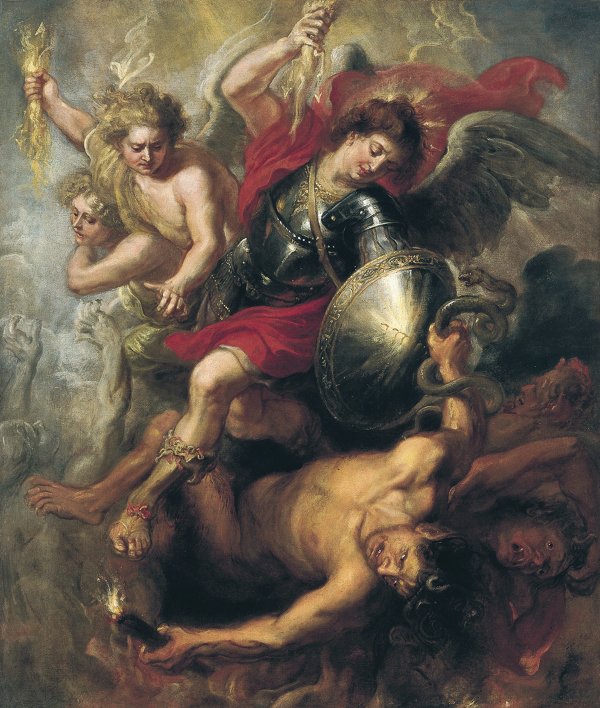
St. Michael expelling Lucifer and the Rebel Angels
Artist: Peter Paul Rubens (ca. 1622)
Museo Nacional Thyssen-Bornemisza, Madrid

In Isaiah 14:12-15 we read why Satan was thrown out of Heaven. Oh yes, he was an angel once but… “How you are fallen from heaven, O Day Star, son of Dawn! How you are cut down to the ground, you who laid the nations low! You said in your heart, ‘I will ascend to heaven; above the stars of God I will set my throne on high; I will sit on the mount of assembly in the far reaches of the north; I will ascend above the heights of the clouds; I will make myself like the Most High.’ But you are brought down to Sheol, to the far reaches of the pit.” Satan wanted to be like God.

But enough ancient history, let’s look at how humanity fell from the perfect relationship with God we once shared in the garden. We all know it was Satan who tricked her but what exactly did he say? Do you know? I mean most people brought up with the Bible know the story but I bet you can’t quite put your finger on what he tempted her with. It wasn’t just a delicious apple. Genesis 3:5 tells us that Satan told Eve, “For God knows that when you eat of it your eyes will be opened, and you will be like God, knowing good and evil.” It was a calculated, diabolical move that Satan knew would get us separated from God like he had been once before. Satan convinced Eve she could be like God.

And Satan is a master at gaslighting humans. He manipulates the world in such a way that leads us to question our thoughts, memories, and the events occurring around us. His greatest weapon is… forgetfulness. Because if he can get us to lose track of EXACTLY what happened in the past we just might fall for it again. Oh and he loves to try his one trick on us all, whispering:

Do you really need to tithe when you could use that money to buy new clothes? You don’t need to follow what God says, you can decide what’s right just as well as God can. ☠️

Gluttony is not a sin in 2021. It’s been a hard year. It’s called self care. Okay so it’s in Proverbs 23 but those are “proverbs” not laws. You do you. ☠️

Sexual immorality? That whole phrase is super vague. I mean… in Matthew 5 it says that if you LOOK lustfully at a woman you have committed adultery in your heart. Don’t you think that’s an impossibly high standard? ☠️

Every time Satan suggests that “it doesn’t really matter this time” he is asking us to believe we are just as good at judging right and wrong as God is. Friends… this the the ultimately audacity of blasphemy straight from Satan. We are not like God. We were created to be in close relationship with Him but that does not mean we are on His level.

Satan is a one trick pony. He has one trick. Just one. And that is to convince you and me and all of humanity that we are just as good as God. It’s what caused him to fall from heaven and he’s good at spreading his fall by causing us to forget. But we won’t! Remember that you will do what is right because God is God and we are not. He is our loving Heavenly Father who would never withhold any good thing (Luke12:32). We can trust his heart. He is for us (Romans 8:32). So next time you wonder if choosing the right really matters… it does. For the love of Christ compelled us (2 Corinthians 5:14-15).

If the Lord is God Follow Him

If the Lord is God Follow Him

We are in a new year – 2021 – and I know there is a lot we need to leave behind. If I am going to be my best self after a year of yoga pants it’s going to be a choice. So here are seven things I tend to do when I am emotionally or physically at my limit – that I need to leave far behind in 2020.

  1. 🏃🏼‍♀️💨 running from problems
  2. ☠️ abandoning relationships
  3. 💬 forgetting what God has done
  4. 🚫 focusing on what God isn’t doing
  5. 👶🏼 assuming nobody else has it as tough
  6. 🚧 giving up
  7. 🤹🏼‍♀️ being very confused about my goals

Now there are lots and LOTS of specific verses dealing with problems and forgetfulness and giving up but I think what Elijah said in 1 Kings 18:21 pretty much sums up what I need to do: “And Elijah came near to all the people and said, “How long will you go limping between two different opinions? If the LORD is God, follow him; but if Baal, then follow him.”

Choices matter. One of the greatest blessings God created in us was free will, but we must use our power to choose correctly. I believe the Lord is God, so I must choose to follow him. I must choose to follow God’s will for my life by facing my problems with determination. I need to prioritize relationships, remember what God has done and focus on what God is doing. I need to stop making assumptions about others, stick with things and be clear on my goals. If the Lord is God, follow him.

That being said, change is difficult. Whoever finds a way to bottle and market motivation and self-discipline will make a fortune. But because that person is NOT me I’ll just give you five ways that help me approach change:

  1. Focus on a change of heart (deep heart-felt desires), not just a change of mind & behavior.
  2. Practice self-discipline. Did you know that self-control is a muscle that, like other muscles, needs exercise and strengthening. Change doesn’t happen because you want it to happen. Each time you resist temptation, you are developing greater self-control.
  3. Eliminate temptation. Whether it is a physical dependence or a psychological dependence, any temptation will distract you from your goals.
  4. Make history your teacher, not your jailer. Instead of beating yourself up when you fail to keep your promises to yourself, seek to gain self-knowledge so you won’t repeat the error.
  5. Surround yourself with people who will support your effort. We are much more influenced by other people than we imagine. One of the most potent forces for positive change is the emotional support of the individuals who surround you.

Do you want to kick the 7 pitfalls to a good 2021 and develop the ability to follow the Lord no matter what?! Use these 5 tips to help you change. We’ve got this beautiful friends!