
You Can Experience God Now!

You Can Experience God Now!

Could it be that God needs to grow us into people who can handle having a deeply personal relationship with Him? It is always easy to point our faces to the sky in exasperation and wonder where God is. After all, we are trying to find Him. We are seeking. Isn’t that our job? To seek?

This my friends is limbo land and we’ve probably all taken up residence here at some point in our lives. Feeling like we are holding up our end of the bargain and begging God to just show up. Seeking. Knocking. Very focused on getting right before God and trying to manage our inevitable disappointment because we just can’t feel Him.

But while we are focused on feeling God’s presence, finding God’s will and knowing what He wants us to do, God is just… here. I know it sounds too good to be true after all our trouble and effort but it’s actually (sorry) not required. Our striving doesn’t earn His notice. He is noticing you right now.

And that’s why I say God may need to grow us to a place where we are able to have a beautiful relationship with Him. Because He is always with us. Jesus’ parting words to His disciples were: “and be sure of this: I am with you always, even to the end of the age.” (Matthew‬ ‭28:20‬)

God is always calling you to see more true reality. He is always looking for your gaze. Never doubt His perpetual protection or wonderful nature. We just need to get better at understanding Him. We need to learn who He is so we recognize Him. Keep our spirits open and sensitive by thinking on holy things. And most of all, we need to believe that God is with us because all too often we find exactly what we are looking for.

Experiencing God isn’t just about doing more – it’s about seeing more clearly.

VERSES TO PONDER:

“He will cover you with his feathers. He will shelter you with his wings. His faithful promises are your armor and protection.” (Psalms 91:4)

“Why do you ask my name?” the angel of the Lord replied. “It is too wonderful for you to understand.” (Judges 13:18)

“Dear brothers and sisters, when I was with you I couldn’t talk to you as I would to spiritual people. I had to talk as though you belonged to this world or as though you were infants in Christ. I had to feed you with milk, not with solid food, because you weren’t ready for anything stronger. And you still aren’t ready,” (1 Corinthians 3:1-2)

“I don’t mean to say that I have already achieved these things or that I have already reached perfection. But I press on to possess that perfection for which Christ Jesus first possessed me. No, dear brothers and sisters, I have not achieved it, but I focus on this one thing: Forgetting the past and looking forward to what lies ahead, I press on to reach the end of the race and receive the heavenly prize for which God, through Christ Jesus, is calling us.” (Philippians 3:12-14)
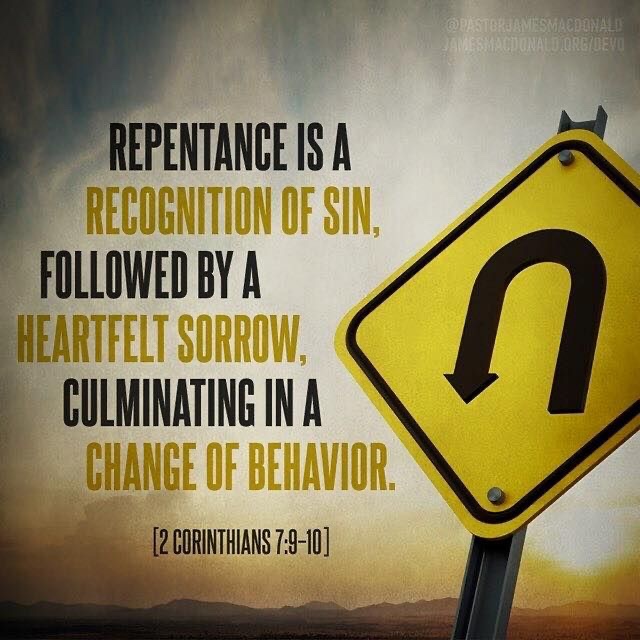
Godly Sorrow: The Distress that Drives us to God

Godly Sorrow: The Distress that Drives us to God

Godly sorrow brings repentance that leads to salvation and leaves no regret, but worldly sorrow brings death. [2 Corinthians 7:10]

I will never forget the year I outlawed the use of the word, “sorry” in my sixth-grade classroom. For some reason, the majority of my students thought that simply saying the word, “sorry” gave them a free pass from any consequence or any need to change their behavior. Saying, “sorry” was the magic word that would stop any authority figure from holding them accountable for their slip-ups and misdeeds and would relieve any feelings of badness and sadness they felt, especially when they were “sorry” about being caught. “Sorry” became the word that could hide them from judgment for breaking the rules, but their version of “sorry” had no power to change their hearts or help them recognize the wounds in relationships they were causing.

So, to move my precious charges from a position of self-centeredness and complete self-absorption, I outlawed the word “sorry” and gave them other phrases to use instead. All year we worked on empathy for others, so that saying, “I have hurt you,” and “This offense is my responsibility,” had a real impact on their hearts. We worked on forgiving and the giving of grace by saying to a classmate dealing with a misstep, “That’s okay, you are still a good person.”

I borrowed a page from the Apostle Paul’s second letter to the Corinthians as I asked God for help with this tough-hearted little crew He had given me to love. Paul’s first letter to the Corinthians had really scorched their hides, demanding accountability for the sin and divisions that had turned their church into a shipwreck. Then, worrying that he had been too harsh, Paul wrote in his second letter to them, that he wanted them to feel the Godly sorrow that would lead to real change.

He wanted them to recognize how truly destructive this current sin-cycle was to their relationship with God, with one another, and within themselves. He didn’t want them to concentrate on outward behavior, but on letting the grace of God and His love penetrate their hearts. Paul wanted the Corinthians to love well, the way Jesus loves, and that meant measuring their behavior by how well they were maintaining loving, healthy relationships. He didn’t want their lives defined by hiding, regret, or being driven away from God and each other by an angry, condemning conscience.

Paul’s Holy Spirit-inspired approach inspired me to help my students move from trying harder to be good and nice and less snarky, to training their hearts to value loving well. Instead of making vows to do better and throwing out a quick, “sorry,” we worked on creating a safe environment where behavior could be evaluated without threat and tools for true change could be discovered and used. I have to admit, that the more deeply we explored this approach, the more of my own “me-sickness” surfaced. God lovingly and gracefully dealt with me, the biggest sinner in that classroom!

What about you? Would you be interested in living a life that leaves no regret, a life defined by true change and healing? Do you want out of the living death of a continuous sin cycle? Embracing Godly sorrow, rather than worldly sorrow is the key. You and I can pray for God to help us turn our perspectives outward so that we have the big picture our sin and mess are creating. The distress we feel at getting caught can be changed to a distress that drives us to a loving Father who is ready to forgive, grant us a do-over, and over time, equip us to love better. We can pray for a more sensitive heart that cares deeplywhen we hurt God, hurt others, and hurt ourselves. That is Godly sorrow. What would it look like in your life?

BY: Stephanie Murillo

For Further Study
2 Corinthians 7: 8-10
2 Samuel 12:13
1 Kings 8:47-50
Matthew 21:32
Matthew 26:75
2 Timothy 2:25-26

Flip the Narrative

Flip the Narrative

I am very ugly
so don’t try to convince me that
I’m a very beautiful person
because at the end of the day
I hate myself in every single way
And I’m not going to lie to myself by saying
There’s beauty inside of me that matters
So rest assured I will always remind myself
That I am a worthless, terrible person
And nothing you say will make me believe
I still deserve love
Because no matter what
I am not good enough to be loved
And I am in no position to believe that
Beauty does exist within me
Because whenever I look in the mirror I always think
Am I as ugly as people say?

👉🏻 NOW, read from the bottom to the top! 👈🏻

It’s all about perspective! What story are you telling yourself in the mirror every single day? Flip the narrative and change the story, it will change your life. I get it, you are saying Liz… if it was that easy we’d all be problem free. And I know changing your perspective is hard. We are usually pretty committed to our perspectives. We have invested a lot in them.

Kind of like Jonah. He was a prophet and committed to telling people to repent and be saved. He did it well. So well, that when God told him to go preach repentance to Nineveh Jonah said “no way”! When he preached people changed and Jonah didn’t want Nineveh to be saved. They were BAD NEWS. So God had to give Jonah a new perspective, being swallowed by a whale.

Inside the whale Jonah finally got the idea that God was in control and God was the one who could save. He got the narrative straightened out. And once he was seeing clearly God could use Jonah again.

Is there a narrative that you need to flip? What are you telling yourself that isn’t true. Maybe you think you are in control when you need to trust. Maybe you are calling ugly what God has called beautiful. Maybe you are running from what you know God has called you to.

Flip the narrative by praying like Jonah! (chapter 2)

Then Jonah prayed to the LORD his God from the belly of the fish, saying, “I called out to the LORD, out of my distress, and he answered me; out of the belly of Sheol I cried, and you heard my voice. For you cast me into the deep, into the heart of the seas, and the flood surrounded me; all your waves and your billows passed over me. Then I said, ‘I am driven away from your sight; yet I shall again look upon your holy temple.’ The waters closed in over me to take my life; the deep surrounded me; weeds were wrapped about my head at the roots of the mountains. I went down to the land whose bars closed upon me forever; yet you brought up my life from the pit, O LORD my God. When my life was fainting away, I remembered the LORD, and my prayer came to you, into your holy temple. Those who pay regard to vain idols forsake their hope of steadfast love. But I with the voice of thanksgiving will sacrifice to you; what I have vowed I will pay. Salvation belongs to the LORD!” And the LORD spoke to the fish, and it vomited Jonah out upon the dry land.

Rebuild Trust

Rebuild Trust

Can trust be rebuilt? Trust has been lost over the last year in a host of ways. It is not hard to see systems break down in our society, career paths squashed, and relationships took a huge hit in our world. Families, friends and just about every one of our relationships were challenged in trust…including our relationship with God.

What happens when things are broken in a relationship? How do we rebuild?

Recently, I heard a Ted Talks on this topic and it talked about rebuilding trust taking three things: authenticity, logic and empathy. These three pieces need to be present when working on a broken relationship.

Authenticity: We really need to be authentic in our relationships or then it is not a real relationship. (Psalm 119:73-74)

Empathy: Empathy is required to have a mutual relationship. It is defined as the ability to understand and share the feelings of another. (Galatians 6:2-3)

Logic: This part of the triangle fascinated me! Logic is the form of communication necessary to have understanding. (I know this is where people throw their hands up and determine that rebuilding trust requires the other person to be logical…but both parties need understanding). She drew a simple triangle to explain logic. (Proverbs 3:5)

Start with the story? Many of us start with story and maybe, maybe get to the point sometime in the future. When there is no trust or empathy, then the story will probably fog up the logic and create confusion in understanding if we ever get to the point.

Start with the point? Most of us should start with the point so it is not lost in the story. When rebuilding trust, we may have an opportunity to share the story when trust is built by the point.       

This is an incredible formula that can be used in every relationship. Think about how you implement this in your life. When I am with people I trust, I tell them the whole story because the all details matter. When I am with someone I don’t trust, I usually get to the point pretty quick (and maybe I should more quickly). I usually try to tell people the story so they have empathy, but I’m learning it doesn’t work that way. Many times when I am telling a story and I see someone mentally check out…I should get to the point and wrap it up.

Hopefully you can take this formula into your life and put it to good use. While human relationships are hard, God does not need a formula. He loves you just the way you are, he is with you in your emotion, and he understands your story. Trust Him while rebuilding trust in other relationships.