Blog

From Timid to Triumphant

From Timid to Triumphant

[Judges 6:12 NIV] “When the angel of the LORD appeared to Gideon, he said, The LORD is with you, mighty warrior.”

     Do you like action movies in which larger-than-life heroes take on the evils of the world?  Chapters 6-8 of Judges would make a great war movie. Still, Gideon, the warrior, and hero began his journey as a terrified, exhausted, vulnerable, bottom-of-the social-barrel farmer from the weakest tribe in Israel. God appears to him while he was hiding from terrible enemies, trying to thresh a little wheat.  Gideon was told God would empower him to fight major battles, but his first step was to “go in the strength you have” (Judges 6:14).  Gideon begins with small steps, first taking down the altar and idols in his daddy’s house.  Now he is about to face his first major battle with the Midianites, who have taken over the Israelite’s land, destroyed their crops and livestock, and taken many innocent lives.  So many challenges!

When you and I go to war against our spiritual enemies, we will face many of the same obstacles that confronted Gideon.  Here are three significant challenges.

[Isaiah 54:17 NIV] “No weapon forged against you will prevail, and you will refute every tongue that accuses you. This is the heritage of the servants of the LORD, and this is their vindication from Me, declares the LORD.”

Spiritual amnesia. God’s people in Gideon’s time had forgotten the incredible feats God had accomplished for them, thinking only they should have the credit for surviving their forty-year trek through the wilderness and their success at building prosperous lives in the promised land.  When we forget what God has done in our lives, our egos tend to become bloated, and we lose touch with God’s reality. When pride is our go-to attitude, a terrible fall in battle is awaiting us.

Failing to exercise the power of humility.  God stripped Gideon’s army down to 300, leaving them no choice but to lean on Him for victory (Joshua 7:4-7).  When God allows our self-reliance and strength to go down in an area, our level of humility and God-dependence almost always goes up.  When we feel equipped and competent, our humility tends to plummet into a pit of pride that hinders God’s work in our lives.  When using our gifts and talents, we need to be even more vigilant about guarding our humility.  We need to thank God for our gifts and talents and see our weaknesses as aids to developing our dependence on our Abba, our Daddy-God.  This attitude can move us from timid to triumphant.

Ignoring God’s weapons to use as our own. God’s weapons for Gideon were clay pitchers with burning torches inside.  When the pitchers were broken, and the incredible light broke forth, shocking and blinding the enemy.  When we let God break our pride and bypass our inadequate agendas, His power can win the battle.

     Gideon moved from a position of weakness to a place of strength because he stayed aware of his dependence on God to bring victory in the battle.  When God, his Commander in Chief, issued directions and battle plans, Gideon obeyed, grateful that he could move on God’s strength instead of being paralyzed by his limitations (Judges 6:14; 34a). The iron chariots of the Midianites were no match for the infinite power and strength of the King of Kings and Lord of Lords!

     What are the “iron chariots” you are facing?  Feeling shaky?  Read Hebrews 11 out loud to yourself and remember that those “heroes” had shaky knees and trembling hearts as well.  Stop a moment to remember the battles God using His weapons has brought you through. Confess your weakness and limitations to a caring, Father.  Ask the Holy Spirit for help to bring strength out of your weakness.  Marinate in Scriptures on how God sees you.  Ask safe others for help.  Like Gideon, you can learn to see yourself as God sees you: triumphant, not timid!

Self-ImageGod-ImageBible Reference
FearfulCourageousJoshua 1:9 & Psalm 138:3
IncompetentCapable2 Corinthians 3:5-6
UngiftedEquipped1 Corinthians 1:4-8 & Hebrews 13:20-23
WorthlessValuable1 Peter 2:9 & Matthew 6:26
RejectedAcceptedJohn 15:16
InsignificantSpecialZephaniah 3:17 & Ephesians 1:3-6

Be a Weeble!

Be a Weeble!

            Life is quite “interesting” sometimes. I say that a bit sarcastically because I have not found a better word than “interesting” to describe some of the seasons I have been through in the last couple of decades. There are ebbs and flows coming and going all the time. What I learned in 2020 is that everything is only for a season. This means no matter where we are, it will really only be a season of life, even if it feels like it’s never-ending. Days feel like years, and years feel like they pass quickly. So weird because it feels as if the dust does not ever settle. The moment one area of life calms down, three more areas get put in motion, and dust begins to fly again! Every time I feel like I have a handle on life, something changes. The only consistent thing is inconsistency. (eye-rolling) (lol)

During all of this, a piece of me waits for the settling of everything: emotional balance, personal security, calm/rest, peace in all ways, earthly understanding, and boundless confidence. That sounds like a Miss America pageant answer, huh?!?? Lol. I believe God puts in each of us a longing for a relationship with our Creator without the distance between earth and heaven. Our humanity really must be accepted for all that humanity entails. Unfortunately, our world will probably worsen before we meet God, so we may want to settle in. Come quickly, Jesus…but in the meantime, I trust you, Lord!

Recently, I have found heightened angst in our world for God to fix our world, heal our land and mend our hearts…He does promise to do so but not yet. This creates typical human angst we all have to live with. This seems to be a “life question” and one we all have to ask ourselves. How can I accept the inconsistent human life with the goal of eternity with God? The short answer is that the only thing consistent in our world is God. In every situation, up or down, ebb or flow, balance or wobble, security or insecurity, calm or struggle, peace or tragedy, knowing or not knowing, confidence or uncertainty…God is with us! Resilience, coping, and getting back up when you get knocked down for the 100th time is imperative. Do you remember Weebles? If you do, then you are saying or singing this right now… “Weebles wobble, but they don’t fall down.” Be a Weeble! It is okay to wobble around the world of humanity with inconsistency, heartache, drama, etc., etc., etc.… but don’t fall down. God has you! Trust anyway, pray anyway, love always, and serve God nevertheless! Be a Weeble!

Psalm 33:18-22

18 But the eyes of the Lord are on those who fear him,
    on those whose hope is in his unfailing love,
19 to deliver them from death
    and keep them alive in famine.

20 We wait in hope for the Lord;
    he is our help and our shield.
21 In him our hearts rejoice,
    for we trust in his holy name.
22 May your unfailing love be with us, Lord,
    even as we put our hope in you.

If you don’t know what a Weeble is, here is the vintage commercial for Weebles. https://youtu.be/qq0OQBdIhsc

Don’t Settle For Nothing When Christ Offers Everything

Don’t Settle For Nothing When Christ Offers Everything

But the serpent said to the woman, “You will not surely die. For God knows that when you eat of it, your eyes will be opened, and you will be like God, knowing good and evil.” – Genesis 3:4-5

How ironic. Adam and Eve were created in the image of God, so they were already like God.

“So God created man in his own image, in the image of God. he created him; male and female, he created them.Genesis 1:27

The serpent offered them NOTHING that they didn’t already have. And this still happens today!

We get dissatisfied with what we have because something else seems nicer, but after obtaining it, we see it’s no better than what we already had. It could be a purse, planner, set of earrings, or shoes. Or something more extensive like a job, place to live, or spouse. We are always looking for something better.

Oh, sister, there is nothing new under the sun.

What has been is what will be, and what has been done is what will be done, and there is nothing new under the sun. Ecclesiastes 1:9

You think the pursuit of something MORE will fulfill your soul. So did Eve, but there is no more to be had outside of God. In him is all.

For by him all things were created, in heaven and on earth, visible and invisible, whether thrones or dominions or rulers or authorities—all things were created through him and for him. And he is before all things, and in him all things hold together. Colossians 1:16-17

Can I encourage you to do this? Before you decide on a new path, take stock of who you are in Christ.

But you are a chosen race, a royal priesthood, a holy nation, a people for his own possession, that you may proclaim the excellencies of him who called you out of darkness into his marvelous light. 1 Peter 2:9

Are you searching for something you already have? So many of us are. I’ve been guilty too. But remember that you were created in the image of GOD. That makes you pretty ridiculously AMAZING.

No, in all these things we are more than conquerers through him who loved us. Romans 8:37

So before you reach for that quick fix that will transform your life, check out the power you already have through Christ. You may just surprise yourself!

I Am Me Because I Am His

I Am Me Because I Am His

In my life I have identified myself in many ways. I am a daughter, sister, wife, mother, and friend. At one time or another I have also been a student, a nurse, a volunteer, and many other things. Something I have noticed when using these labels and titles over the years is that a true sense of identity seems near impossible to hold on to. While social media offers us a way to stay connected, it also plays a role in why so many of us struggle to feel secure in who we are. Behind every corner is another person posting or bragging about their newest title or achievement. Seeing other’s lives through only a highlight reel can very easily distort our idea of what identity and connection are truly supposed to look like.

So, where can we find our identity? How can we feel confident in being the woman that God created us to be? The world tells us that the answer is complicated, but with Him it is simple. The answer is found in faith. When we ask Him, “What is my identity?” His answer is a resounding, “You are the daughter of the King of kings!”

Even with an identity firmly rooted in being a cherished child of God, there’s still work to do. We’re called to connect. Before we can connect with others, we must invest in a connection with Him. We do this by inviting the Holy Spirit into our lives and walking with Him always. Walking daily with our Savior may look different to each individual woman. For many, it looks look like daily devotional in the Word. For others, it may look like worshipping God through song on the commute to work. It can also look like an evening prayer each night where you can bring all the day’s blessings and heartaches to the Father in conversation. Whatever your daily walk with Christ looks like, an important thing to remember is that we are fiercely loved by the Creator of the universe, and He whole-heartedly desires a personal relationship with each one of us as individuals.

Below you’ll find a prayer, a song, and some wonderful Bible verses to help you further embrace your identity in Christ and begin today’s walk with Him.

Prayer:

Lord, I pray that you would open my heart to see that my true identity is found in you. Give me the strength and the passion to stand in Your truth, and to walk with You daily. Help me to let go of the ways that I have tried to establish myself within this world. Help me to see myself the way that You see me. Thank you, Lord, for this unique identity I have in You. Help me to continually strengthen my relationship with You, every day. In Jesus’ name, Amen.

Song:

Can’t Live a Day by Avalon

Bible Verses For Additional Study

John 1:12; Genesis 1:27; and Galatians 2:20

From Broken to Blessing

From Broken to Blessing

[2 Corinthians 4:7 NIV] 7 But we have this treasure in jars of clay to show that this all-surpassing power is from God and not from us.

What do you think when you hear the word “broken”?  Do you see images of shattered hearts, cracked bones, or betrayed trust?  On a positive note, might you consider Gideon’s broken jars of clay that let out the fire from the torches within, lighting the way to victorious battle (Judges 7:20)? What about the alabaster box that had to be broken so that the woman could pour the spikenard ointment on Jesus (Matthew 26:7)?  Don’t forget the outer shell on buried seeds of wheat that must be cracked open by the heat and humidity so that the life within can break forth (John 12:24).

    Scripture also paints us as a bunch of ordinary, very breakable clay pots, humble containers holding a cache of God’s “all-surpassing power” (2 Corinthians 4:7). The pot represents our outer shell, our natural way of thinking, choosing, feeling, and acting.  The “treasure” inside is the powerful, eternal life, the Holy Spirit, that entered us when we confessed our sin and our mess to Jesus and asked Him to live inside our hearts.  But for this powerful, resurrected life to pour forth, the jar of our natural self and ego must be broken.  Watchman Nee, a Chinese evangelist and Christian martyr of the mid-twentieth century, wrote that our focus should not be on obtaining the powerful life of Christ but instead on allowing His life to pour out of our clay jar.  He wrote:

“It is not that the life of the Lord cannot cover the earth but rather that His life is imprisoned by us. It is not that the Lord cannot bless the church but that the Lord’s life is so confined within us that there is no flowing forth. If the outward man remains unbroken, we can never be a blessing to His church, and we cannot expect the Word of God to be blessed by Him through us!”

The woman who anointed Jesus in Matthew 26 had her priorities straight.  Although the alabaster box was beautiful, she did not hesitate to break it, valuing the pure spikenard inside much more.  So, the questions we might ask ourselves are, “Do I treasure my importance, my appearance, my superior judgment, my bright brain, my way with words, my pile of pennies, or my set of rules, more than the life of Christ within me?  Am I an antique collector, a vase admirer, or do I want the fragrance of Christ within me released into the world?”

     For us to do the good God says is our purpose, our Abba, our Daddy-God has to break the clay of our old nature so that His light can shine forth to bless the world.  I confess that I sometimes become very ungrateful and uncomfortable when my Abba begins the process of breaking my pride, my misconceptions, my “stinkin’ thinkin’,” and my selfishness.  Defaulting to complaining when I don’t initially see how God can work my situation for good is a constant temptation.

    The key to responding to the brokenness that leads to blessing is to start each day with renewed surrender to a good, loving, just, and compassionate Father.  Watchman Nee prayed, “Lord, I offer myself without condition, without reservation, into Your hands.  Have your whole way through me.”  That prayer sustained him through twenty years of imprisonment until God released him by gathering this great preacher and writer to Himself in 1972.

   Will you let God break that tired, old, imprisoning shell of clay so that His mighty love and loving power can be released through you? Will you transform from being broken to being blessed? The timing of this life-long process is perfect for each of us, for God knows us well and will lovingly walk through refining fires with us.

Verses for Clay Pots:

  • Proverbs 3:5-6
  • Hosea 10:12
  • 2 Corinthians 1: 8-10
  • James 4:6
  • Galatians 2:20
  • Acts 20:24

Who’s Job is it Anyway?

Who’s Job is it Anyway?

     Did you know that the mind loves patterns?  The Bible is full of ways or themes that help us see God’s big picture for our lives.

     One of the most significant patterns in the Bible teaches us about God’s role and our role as we “work out our salvation” (Philippians 2:12).  As we grow, confusion about who is to do what job can create heavy burdens God never intended for us to carry.

God is the Provider for us

    In Genesis, four big ideas surface quickly about God’s job and our job.  The first pattern shows God as the Source and the Provider for Adam and Eve and all those who descend from them.  Adam and Eve’s job was to depend on God as the source. When we apply the hard lesson they learned to our own lives, we must not only be dependent on God as the source but against our default setting of self-sufficiency.  Our job is to recognize how limited we are and then turn to God and godly others to help us live a life that really works.  When we face the fact that we need both God and Christ-like mentors, we find a truth that frees us from the slavery and futility of trying to be the source of life for ourselves and others.

God is in control and we need to yield control to Him

    The second idea stitching Scriptures together is that God’s job is to be in control, and our job is to yield to God’s control of the world and ourselves. Adam and Eve learned this hard lesson when they decided to eat from the tree of knowledge of good and evil. They wanted to take control of their future rather than trusting God. Can you remember times when you tried to control everything, and everyone then found you had lost control of yourself? I can! When we push God off the throne to try to manage the big picture, we lose sight of ourselves and our responsibilities, leaking all kinds of destruction and dysfunction everywhere we go.

We get to experience the life that God has provided us, and God is the judge of that life.

    The third pattern in the Bible’s grand tapestry is the idea that God is the Judge of Life, and our job is to experience life. When Adam and Eve tried to take on God’s role, they could no longer experience the life God had designed for them. When we become judges, we can quickly become obsessed with the question, “Am I good enough?” Life can become a numbers game in which we incessantly rate ourselves and others on a scale God never meant for us to use.

God is the rule maker and as children of God, we must obey.

    The fourth big idea is that God made the rules; we are to obey them. When Eve listened to the serpent and ate the forbidden fruit, she disobeyed God’s laws. Since that happened, some severe consequences have lasted even to this day. Do you have some of God’s rules you would like to re-write? God’s mandates or guardrails were designed to protect us from death and destruction and to guide us to discover the wisdom that breathes life, fulfillment, and joy into the jobs we do.  Constantly redesigning life and making new rules is a form of slavery from which Jesus came to set us free.

     Doing God’s job is exhausting!  Relaxing into our God-given role will restore us to the restful, life-giving, loving design God created for us before Adam and Eve took a dreadful tumble trying to become “like God.” Will you let God be the boss and restore you to the job He created you to do?

Prayer:

Abba, my Daddy-God, I need Your help, or I will become self-sufficient, controlling, and judgmental.  I confess that I had written my own rules for life and became angry and disappointed when others didn’t follow them.  Help me surrender to You as the source of my life.  Help me connect to safe others. Holy Spirit, I need Your energy and Your coaching to help me return to the role God created for me.  Please give me Your fruit of self-control as I give up trying to do Your job and learn to do my own.  I want to do life Your way, Lord.  Thank you so much for being so patient with me.  Amen.

Bible Verses for Additional Study:

Philippians 3:12-14

Titus 2:14

1 Corinthians 6:19-20

Romans 8:39

Got Word?

Got Word?

[1 Thessalonians 2:13 NIV] 13 And we also thank God continually because, when you received the Word of God, which you heard from us, you accepted it not as a human word, but as it actually is, the Word of God, which is indeed at work in you who believe.

      There are so many processes at work in us! Millions of cells are hard at work inside our bodies in a primarily invisible cycle that keeps us alive. But there is a greater force at work in us when we choose to open our Bibles and receive the life inside: the Word of God.  The Apostle Paul acknowledges this compelling fact when he writes to the new believers in Thessalonica. They recognize that their teachers are not just bringing human words to them but the very Word of God. Paul’s letter is not just ink on a page, but a living, compelling message inspired by God’s Spirit within him, and that message is doing a mighty work in those believers by turning them away from idols, to worship and serve a living, and true God.  Because God’s Word is working in them, they also begin to live lives of joy, a settled confidence that God is who He says He is and can do what He says He can do, even though they are enduring great persecution because of their faith. 

     Is this some sort of magic?  No!  The words written in the Bible have incredible power to transform us because God and His Word are inseparable. God is the author of His Word, so we can trust the authority of what we are reading.  God’s written Word is called “rhema.”  The rhema word, the “God-breathed word,” is what we receive when we open our Bibles and begin to seek God’s personal message of hope, life, and transformation (2 Timothy 3:16). The rhema Word of God is what Paul speaks about in Ephesians 6:17 when he says to pick of the “Sword of the Spirit.” The more we read, meditate, study, obey and pray through the Word, the more we become like Jesus, equipped to handle the challenges life throws at us daily. Jesus demonstrated this when Satan confronted Him in the wilderness by answering, “It is written: ‘Man shall not live on bread alone, but on every word that comes from the mouth of God.’” (Matthew 4:4) He quoted the rhema-word in Deuteronomy, and the authority of God’s Word caused His enemy to withdraw, a beaten foe.  The power of God’s Word can only defeat the doubt that can lead to outright denial of our faith. Got Word?

     But wait! There’s more!  An old saying reminds us, “Every time you read the Bible, the Bible is reading you.”  God’s Word penetrates where no surgeon’s scalpel can safely go, and no probing of a psychiatrist can reach to diagnose, heal, and create growth in us. Take a peek at the following ways God’s Word works in us:

  • Growing faith (Romans 10:17)
  • A new birth (James 1:18; 1 Peter 1:22-23)
  • Food that sustains (1 Peter2:2; Hebrews 5:12-14)
  • Truth-filled minds (Psalm 119:130).
  • Spiritual and physical healing (Psalm 107:17-20).
  • Victory over sin (Psalm 119:9-11).
  • Cleansing and holiness (Ephesians 5:25-27).
  • The revelation of our inner self (James 1:23-25).  

The strength, peace, faith, hope, and love we need are waiting to be discovered between the pages of our Bibles.  As we test-drive God’s promises each day, our insides will finally start matching our outsides, and we can grow to do some good in this hurting world. 

Derek Prince suggested this pre-reading prayer:

“Lord, I believe this is Your Word.  I receive it as Your Word.  Let it work in me everything You sent it to do in every area of my being: spirit, soul, and body because I believe it.”

Written by Stephanie Murillo

For further study:

Psalm 119

Jeremiah 23:28-29

Luke 8:21

Fragile: Handle With Care

Fragile: Handle With Care

“Let your gentleness be evident to all.  The Lord is near” [Philippians 4:5].

     When was the last time you prayed for the fruit of gentleness to bloom in your life?  My first experience with this prayer came out of the trauma and a form of PTSD that developed in my early adolescence.  After being victimized by a family member, anxiety and depression dogged me for decades. In my forties, a dear friend led me toward a time of relinquishing my desire for a piece of revenge and justice, even though the person who hurt me was no longer alive.  The idea that I could have a gentle response toward this person and myself never occurred to me until the January afternoon I prayed with her for God to let me see this individual with what one of my other friends calls “soft eyes.”  Not long after a season of praying that prayer, God opened the heart of a distant relative who shared family stories of struggle in the early life of the one who wounded me.  I found compassion for this broken soul that helped me release this person into God’s loving hands.  God’s gentleness toward me during this period helped me forgive my relative and open my torn heart to God’s healing.

     We need gentleness because we are fragile!  God designed us for the Garden of Eden, not this harried and hurried existence out here in the tumbleweeds of a fallen world. Isaiah 40 tells us that God has the kind of strength needed to be gentle to us.  Sandwiched between the power of verses 15, 26, and 27 is the kindness of verse 11:

“He tends his flock like a shepherd; He gathers the lambs in his arms and carries them close to his heart; He gently leads those that have young.”  

  Gentleness Stoops Down 

     In his book, The Practice of Godliness, Jerry Bridges points out that “God continually stoops down to help us (Psalm 18:35), and He wants us to do the same; to be sensitive to the rights and feelings of others.”  Jesus modeled this gentleness constantly; He actively sought to make others feel at ease and rest in His presence (Matthew 11:28-30).  I tend to hold my breath around people who are not being gentle.  I now wonder, who might be holding their breath around me?

Gentleness Respects the Dignity of Others

      Respect is an essential component of gentleness.  When we seek to change a wrong opinion with persuasion and kindness instead of domination or intimidation, we use the Holy Spirit’s gift of gentleness. Remembering that “The Lord is near,” not only watching but offering help, may encourage us all to deal more gently with everyone, doing what is best for them.

Developing a Gentle Spirit

    We can train to develop a more considerate stance toward people.

  1. Choose to enter training to develop a gentle spirit.  Are you willing to live without a rigid set of black and white rules?  Do you really want to care about people? You can pray for a soft heart and “soft eyes” with which to see those around you.
  2. Ask honest people who know you well about how you come across to others.  Are you willing to accept feedback?  Are you ready to look at where you might be dogmatic and opinionated, blunt and abrupt, dominating and intimidating?  Do people feel judged by you?  The Holy Spirit wants to help you develop more loving strategies to deal with the people in your life.  You will need great strength for this, so ask boldly for God’s power to help you.
  3. Pray for the Holy Spirit to open your eyes to specific instances in which a gentle spirit did not surface.  Ask for forgiveness and a do-over.
  4. Read, think about, and memorize Scriptures on gentleness.

Prayer:

     Holy Spirit, please give me a gentle spirit that puts people at ease around me.  Help me value people enough to let You change me.  Amen.

For Further Study:

1 Timothy 4:5

Titus 3:2

James 3:17

Colossians 3:12

Galatians 5:22-23

Written by Stephanie Murillo

Godly Sorrow: The Distress that Drives us to God

Godly Sorrow: The Distress that Drives us to God

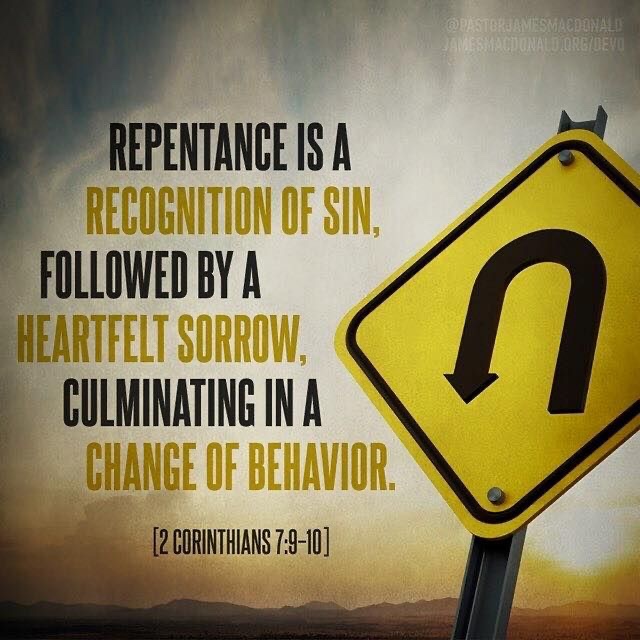
Godly sorrow brings repentance that leads to salvation and leaves no regret, but worldly sorrow brings death. [2 Corinthians 7:10]

I will never forget the year I outlawed the use of the word, “sorry” in my sixth-grade classroom. For some reason, the majority of my students thought that simply saying the word, “sorry” gave them a free pass from any consequence or any need to change their behavior. Saying, “sorry” was the magic word that would stop any authority figure from holding them accountable for their slip-ups and misdeeds and would relieve any feelings of badness and sadness they felt, especially when they were “sorry” about being caught. “Sorry” became the word that could hide them from judgment for breaking the rules, but their version of “sorry” had no power to change their hearts or help them recognize the wounds in relationships they were causing.

So, to move my precious charges from a position of self-centeredness and complete self-absorption, I outlawed the word “sorry” and gave them other phrases to use instead. All year we worked on empathy for others, so that saying, “I have hurt you,” and “This offense is my responsibility,” had a real impact on their hearts. We worked on forgiving and the giving of grace by saying to a classmate dealing with a misstep, “That’s okay, you are still a good person.”

I borrowed a page from the Apostle Paul’s second letter to the Corinthians as I asked God for help with this tough-hearted little crew He had given me to love. Paul’s first letter to the Corinthians had really scorched their hides, demanding accountability for the sin and divisions that had turned their church into a shipwreck. Then, worrying that he had been too harsh, Paul wrote in his second letter to them, that he wanted them to feel the Godly sorrow that would lead to real change.

He wanted them to recognize how truly destructive this current sin-cycle was to their relationship with God, with one another, and within themselves. He didn’t want them to concentrate on outward behavior, but on letting the grace of God and His love penetrate their hearts. Paul wanted the Corinthians to love well, the way Jesus loves, and that meant measuring their behavior by how well they were maintaining loving, healthy relationships. He didn’t want their lives defined by hiding, regret, or being driven away from God and each other by an angry, condemning conscience.

Paul’s Holy Spirit-inspired approach inspired me to help my students move from trying harder to be good and nice and less snarky, to training their hearts to value loving well. Instead of making vows to do better and throwing out a quick, “sorry,” we worked on creating a safe environment where behavior could be evaluated without threat and tools for true change could be discovered and used. I have to admit, that the more deeply we explored this approach, the more of my own “me-sickness” surfaced. God lovingly and gracefully dealt with me, the biggest sinner in that classroom!

What about you? Would you be interested in living a life that leaves no regret, a life defined by true change and healing? Do you want out of the living death of a continuous sin cycle? Embracing Godly sorrow, rather than worldly sorrow is the key. You and I can pray for God to help us turn our perspectives outward so that we have the big picture our sin and mess are creating. The distress we feel at getting caught can be changed to a distress that drives us to a loving Father who is ready to forgive, grant us a do-over, and over time, equip us to love better. We can pray for a more sensitive heart that cares deeplywhen we hurt God, hurt others, and hurt ourselves. That is Godly sorrow. What would it look like in your life?

BY: Stephanie Murillo

For Further Study
2 Corinthians 7: 8-10
2 Samuel 12:13
1 Kings 8:47-50
Matthew 21:32
Matthew 26:75
2 Timothy 2:25-26

Smelling Like Jesus

Smelling Like Jesus

Now thanks be to God who always leads us in triumph in Christ and through us diffuses the fragrance of His knowledge in every place. [2 Corinthians 2:14]

What is your favorite scent? What aroma do you find most tantalizing? The smell of baking bread? The way the air is perfumed after a rain? What perfume really pleases you? The apostle Paul spoke of his favorite scent in 2 Corinthians 2:14. To understand the context, you have to attend a once-in-a-lifetime Roman parade!

In Paul’s day, after a hard-fought, long and arduous campaign, the victorious Roman general would return home in a triumphant, loud, colorful, parade. What a spectacle! The procession would be led by state officials followed by trumpeters filling the city with ear-splitting blasts. Then large drawings and of the conquered lands and models of fallen citadels would be carried in to the cheers of the crowd. A white bull, destined to be sacrificed, was also a part of spectacle. Chained captive princes, leaders, and generals came next, knowing that prison and execution awaited them at the parade’s conclusion. Officers in charge of punishment, called lictors, brandished their rods as they followed the prisoners. Then came the musicians with lyres followed by priests swinging their censers with sweet smelling incense burning in them. Finally, the general and his army paraded in, wearing all their decorations and garlands, shouting, “lo triumphe!” a cry of triumph. What sights! What sounds! What sweet aromas! Feast your eyes, indulge your nose, for you may never see or smell another one of these parades in your lifetime!

This is the picture Paul has in mind in 2 Corinthians 2:14. He sees Jesus, God’s Christ, marching in triumph throughout the world in a victorious, fragrant parade. You and I, as believers, are part of that magnificent profession! The loving, Christ-like way in which we live our lives is the perfume that wafts over the onlookers, drawing them to Jesus. All the sweetness, tenderness, courtesy, unselfishness, and desire to build others up combine to make the “fragrance of Christ” a scent of selfless love that invites others to join the parade.

Realizing that you and I leave a spiritual scent-trail as we move through each day, perhaps we should ask ourselves, “What kind of aroma or odor does my behavior and attitude release into the world?” I have to confess that my times of selfishness or anger have released some pretty noxious clouds of “Stephanie-stink” into the room. The “fragrance of Christ” was nowhere to be found! No wonder people ran for their lives!

The key to perfuming the world with the love of Christ begins the moment we awaken in the morning. We can pray, “Holy Spirit, help me choose the right scent today. I want to smell like Jesus.” As believers, we can ask our divine Coach to energize our desire to wear Eau de Love instead of going out into the world reeking of self-pity, self-righteousness, or any of the other stenches that come from our smelly, unwashed flesh. We can pray for help because our Daddy-God, our Abba receives us with such grace and mercy. When he sniffs the stink of self, He tells us that we don’t smell good, then offers to wash us with the healing soap of His Word. Our job is to admit we stink, jump in the tub, then, in gratitude for Jesus’ love for us, carry His perfume out into the world.

BY: Stephanie Murillo

Scripture Soap:

  • 2 Corinthians 2:14-16
  • Ezekiel 20:41
  • Ephesians 4:2, 15
  • Ephesians 5: 2
  • Psalm 51